Homeopathy for lung cancer – five years after the study was published, it was finally retracted by the journal “The Oncologist.”
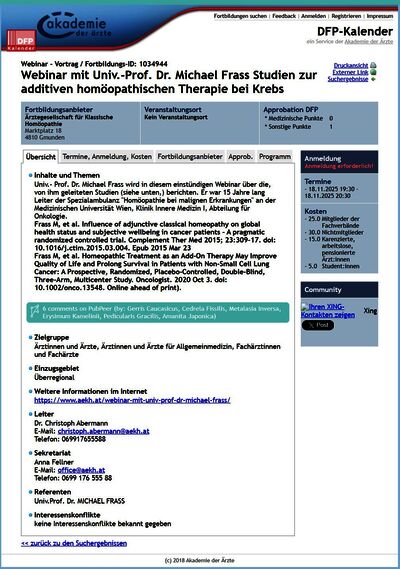
The CME event could be found on the ÄKH website (snapshot, as it is no longer online), and the publication we criticized was described as completely rehabilitated.
Quote:
Two years later, serious allegations were made against the research team. The authenticity of the study was questioned, and there was talk of manipulation and fraud. University Professor Dr. Michael Frass and his colleagues responded in writing and in great detail to all the allegations, and the facts they presented refuted all the accusations – with the gratifying result that the journal “The Oncologist” confirmed in September 2024 that it would not retract the article published in 2020. It rehabilitated Prof. Frass and his team with an editorial confirming the value of the study.
End of quote
In October 2025, the ÄKH website (snapshot, as it is no longer online) announced this webinar by Michael Frass with the message that the study had now been retracted after all.
Quote:
In October 2025, there was another attack on the study with arguments that were absurd from a homeopathic point of view, namely that Michael Frass had changed the dosage and potency during the treatment of the study patients and that he had used the same remedies in his practice as in the study (conflict of interest).
End of quote
The CME event took place on November 18, 2025.
Retraction of the study
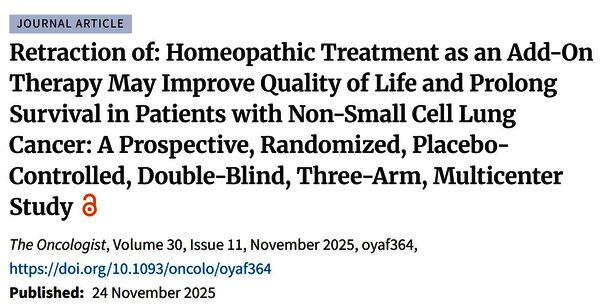
On November 24, 2025, the study was finally marked as retracted on The Oncologist website. However, contrary to the earlier information on the ÄKH website, the reason given in the retraction notice is completely different:
Quote:
Subsequent to the two corrections, concerns have continued to be raised about the study. In light of this continued uncertainty and the issues previously covered in the corrections, the journal no longer has confidence in the results and conclusions reported in the article and has decided to retract.
Many co-authors disagree with the journal’s decision to retract6, while one agrees7 and others have not commented either way.
End of quote.
The journal therefore no longer has confidence in the results and conclusions presented in the article.
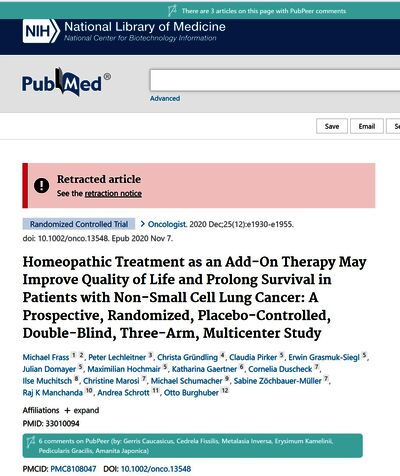
The English-language version of the ÄKH website still contains praise for the study dated November 14, 2024. (Snapshot from December 1, 2025).
A discussion of the specific points of criticism raised from the outset is still pending.
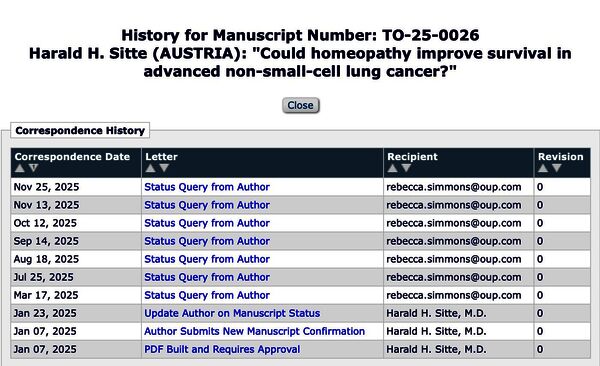
The situation regarding the commentary on the editorial and the corrections requested from Harald Sitte by The Oncologist remains unresolved. It was submitted in January 2025 and reviewed by reviewers in June, but to date (November 25, 2025) there has been no decision on publication, the reviewers' findings have not been communicated, and inquiries have not been answered.
Conclusion:
It took an immense amount of time and effort and five years of intensive collaboration between representatives of Meduni Vienna, ÖAWI, the Homeopathy Information Network, and the Initiative for Scientific Medicine to remove this publication, which was completely implausible from the outset, from the scientific literature (see chronology)
Even with a renowned publisher such as Oxford University Press and a reputable journal such as The Oncologist, a public discussion of factual arguments put forward by readers was not made possible.
The Medical Association's Pysicians' Academy awards CME points for pseudo-medical training courses based on the content of a retracted study.
Udo Endruscheit has analyzed the matter on the website of the Information Network Homeopathy. (in German)